

Engineered Package vs Material Supplier Decisions
A framing quote can look complete and still leave the most expensive questions unanswered. In an engineered package vs material supplier decision, the real issue is not the price per stud or the lead time on steel. It is who resolves the framing system before crews, lifts, and critical-path trades arrive on site.
For commercial projects under schedule pressure, that distinction affects labor exposure, RFIs, trade coordination, waste, and the owner’s confidence in the delivery plan. One option delivers components. The other delivers a coordinated scope of work designed to install.
What You Are Buying From a Material Supplier
A material supplier primarily fulfills a product order. The supplier may provide cold-formed steel studs, track, joists, connectors, clips, fasteners, and accessory items based on a takeoff, a specification, or a set of plans. That service has a place, particularly on straightforward work with an experienced field team and a stable, fully coordinated design.
But materials are not a framing system.
With a conventional material purchase, the general contractor, framing contractor, or field superintendent often carries the responsibility for turning drawings and material into an installable sequence. They must interpret details, reconcile architectural and structural information, identify missing conditions, manage substitutions, coordinate penetrations, account for deflection and fire-rated assemblies, and decide how framing interfaces with other trades.
Those decisions are not always visible in the bid. They emerge when the crew reaches a condition that was never fully resolved on paper. A wall shifts to clear ductwork. A header conflicts with a beam. A truss bearing point does not align with the layout below. A connection requires an unplanned clip or reinforcing condition. Then the project begins paying for questions that should have been answered earlier.
That does not make a material supplier the wrong choice. It means the project team needs to understand what remains outside the supplier’s scope. If the field has the capacity, experience, and time to absorb that coordination, a material-based procurement model can work. If the project is compressed, repetitive, multi-story, or highly coordinated, the unpriced effort can become a significant risk.
Engineered Package vs Material Supplier: The Practical Difference
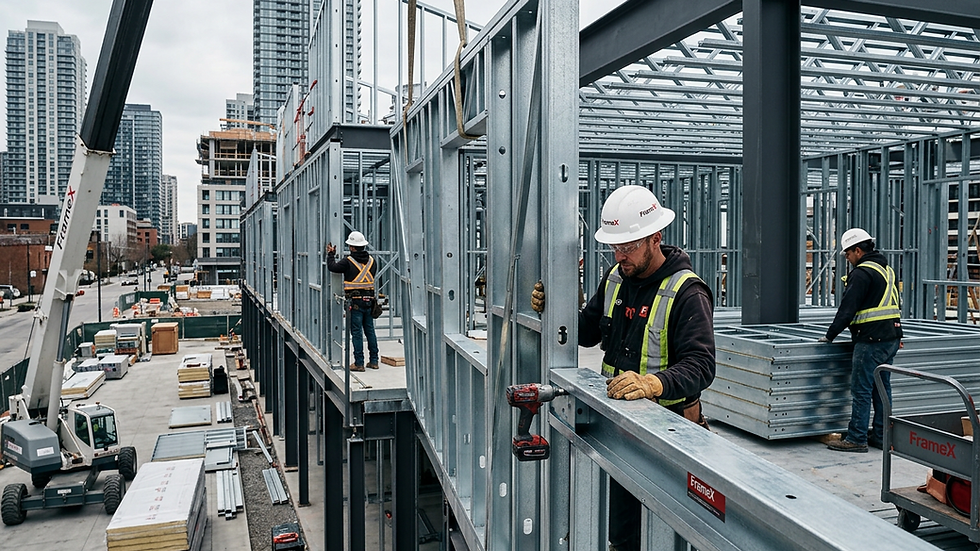
An engineered framing package changes the handoff. Instead of purchasing raw inputs and asking the field to assemble a solution, the project receives a resolved, engineered system prepared for installation.
The work starts upstream with a constructability review. Plans are evaluated not only for what they specify, but for how the framing can be built. Architectural intent, structural requirements, loading conditions, openings, wall heights, floor and roof geometry, and trade interfaces are reviewed together. The objective is direct: solve conflicts before they become field decisions.
From there, the system moves through engineering and digital coordination. The framing model is developed around actual project conditions, not generic assumptions. Details are clarified, member sizes are confirmed, connection requirements are addressed, and panel layouts are organized for production and installation. When required, the structural package is stamped and issued as part of a coordinated framing scope.
Manufacturing follows the approved information. Wall panels and truss components are produced to the coordinated model, labeled for sequence and location, and delivered to support the installation plan. The field is no longer starting with bundles of steel and a stack of unresolved details. It is receiving components that have a defined role in a larger system.
The difference is accountability. A material supplier is accountable for supplying materials. An engineered package provider is accountable for developing and delivering the framing solution within its defined scope.
Where the Cost Difference Actually Shows Up
Comparing these options only by material price creates a false economy. The lower initial quote can be attractive because it excludes work that is difficult to quantify at bid time: coordination, engineering, field layout, cutting, staging, rework, waste, and supervision required to keep production moving.
On a simple project, those costs may remain manageable. On a multifamily development, hospitality project, student housing building, senior living facility, or other commercial structure with repeated units and dense MEP coordination, they compound quickly. One unresolved condition can repeat across dozens or hundreds of locations.
An engineered package often carries a higher visible upfront cost because more of the work is being done before fabrication and delivery. That is not added complexity. It is complexity moved to the point where it can be managed with drawings, models, engineering review, and controlled production rather than labor, overtime, and change orders.
Project teams should ask a more useful question than, “What is the steel cost?” Ask, “What will it take to make this scope installable?” The answer should include field labor, schedule contingency, RFI exposure, waste, site storage, crane or forklift time, trade conflicts, and the cost of having skilled supervisors solve problems in real time.
Schedule Control Begins Before Fabrication
The jobsite is a poor place to discover that framing geometry does not work. By the time an issue reaches the field, crews may be waiting, materials may be staged in the way, and follow-on trades may be working against an uncertain layout. A single unresolved interface can disrupt several scopes at once.
An engineered package creates schedule control by shifting decisions earlier. Coordination occurs while changes are still comparatively inexpensive. Manufacturing can be planned around approved production information. Deliveries can be sequenced around the installation plan rather than sent as broad material releases that require significant site sorting and handling.
Panelization also changes the labor equation. Factory-built wall and truss components reduce the amount of measuring, cutting, and assembling required in the field. Crews can focus on setting, fastening, aligning, and advancing the structure. This does not eliminate the need for qualified installation labor. It makes that labor more productive by reducing the number of variables it must manage.
For general contractors, the benefit is not simply faster framing. It is more reliable framing. A predictable framing start and sequence protects the trades that follow, including MEP rough-in, exterior enclosure, drywall, and finishes.
The Questions to Ask Before You Buy
The procurement decision should be based on project conditions, not a default purchasing habit. Before awarding framing scope, establish where responsibility sits for engineering, constructability, BIM coordination, detailing, fabrication, delivery sequencing, and field issue resolution.
Ask whether the quoted scope includes stamped structural engineering where required, or whether the project must separately procure and coordinate it. Confirm who identifies conflicts between framing and MEP systems. Determine whether components will arrive as installation-ready panels and trusses or as loose materials requiring field assembly. Clarify what information drives fabrication and what happens if drawings conflict or change.
Also examine the production plan. A supplier with material availability is not necessarily prepared to support the installation sequence. Delivery timing, panel labeling, loading strategy, site access, and release schedules should be treated as operational requirements, not logistics afterthoughts.
The strongest proposals make these answers clear. They define inclusions, identify assumptions, and establish a workflow for moving from plans to coordinated production. Ambiguity at buyout rarely stays contained. It moves downstream, where it becomes a schedule or cost problem.
When a Material Supplier May Be Enough
There are situations where a material-only approach is appropriate. A small, uncomplicated build with clear documents, limited MEP density, accessible site conditions, and a capable local framing crew may not require a full engineered panel package. The project may benefit more from purchasing flexibility than from extensive prefabrication.
The same can be true when the scope is highly variable and design information is still changing late in the process. Factory production depends on disciplined approvals. If the team cannot make timely decisions, prefabrication can lose some of its advantage.
Even then, the project should not confuse flexibility with lack of planning. The field still needs coordinated answers. It simply retains a greater share of the responsibility for creating them.
Choose the Delivery Model That Matches the Risk
The right choice depends on where a project can tolerate uncertainty. If the job has ample float, simple geometry, and a field team built to solve conditions as they arise, material supply may be sufficient. If the project depends on faster turnover, consistent quality, tighter labor control, and fewer trade conflicts, a complete engineered framing package is usually the more disciplined path.
Frame X Systems approaches framing as a project execution strategy: design assist, engineering, digital coordination, panelized manufacturing, and delivery organized around installation. The goal is not to sell more steel. It is to remove avoidable decisions from the jobsite.
Before issuing the next framing purchase order, identify the questions your field team would otherwise inherit. The best time to solve them is while they are still lines on a drawing, not delays on the schedule.


Comments