
How to Streamline Framing Submittals on Schedule
- steve107563
- 1 day ago
- 6 min read
A framing submittal can look complete, move through review, and still leave the field team with unanswered questions. A wall layout may not account for MEP penetrations. A truss reaction may conflict with an architectural opening. A material package may be approved before connection details are fully resolved. Knowing how to streamline framing submittals means preventing those gaps before they become RFIs, rework, or schedule losses.
For commercial projects, the objective is not simply to get an approval stamp. The objective is to release a coordinated, buildable framing system that installers can execute with fewer field decisions. That requires a different approach to scope definition, document control, engineering, coordination, and release planning.
Treat the Submittal as a Construction Package
Traditional material submittals often focus on product data, gauges, finishes, and manufacturer information. Those documents are necessary, but they do not prove the framing system will work in the building. A complete framing submittal must connect the structural intent, architectural requirements, delegated design responsibilities, and installation sequence.
That distinction matters most on multifamily, hospitality, senior living, student housing, and other repetitive projects where small conflicts multiply across floors. One unresolved condition at a typical wall can create dozens of field fixes. By the time that issue reaches the superintendent, the cost is no longer confined to framing. It affects drywall, MEP rough-in, inspections, and follow-on trades.
Start by defining what the submittal is expected to resolve. For a panelized cold-formed steel scope, the package should establish panel layouts, stud and track sizes, header conditions, truss geometry, load paths, connections, openings, bracing requirements, and interface conditions. If a condition is intentionally excluded or deferred, identify it plainly. Ambiguity is not flexibility. It is unassigned risk.
Set Submittal Ownership Before Design Advances
Most submittal delays are ownership failures disguised as drafting problems. The team has drawings, but no one has confirmed who provides the final answer for a wall-to-structure connection, a deflection condition, a backing requirement, or a clash with another trade.
Establish a responsibility matrix at the beginning of preconstruction. The architect should confirm design intent and finish-sensitive conditions. The structural engineer should establish the primary structural system and delegated design criteria. The framing engineer and detailer should develop the engineered framing solution within that criteria. The general contractor should control decision timing, trade inputs, and document flow.
This does not require a long administrative exercise. It requires direct alignment on a few critical questions:
What framing elements are delegated design, and what performance criteria govern them?
Which openings, embeds, loads, and attachments must be supplied by others before engineering can be finalized?
Who has authority to resolve conflicts when architectural, structural, and MEP documents do not agree?
What is the approval path for coordinated shop drawings, calculations, substitutions, and revisions?
The key is timing. These decisions must be made before detailed engineering begins, not after the first review cycle produces a list of avoidable comments.
Build From Current, Controlled Inputs
A submittal cannot be better than the information used to create it. Teams frequently lose weeks engineering from an incomplete permit set, an outdated architectural background, or a structural issue that was superseded without clear distribution. The result is a technically sound package that no longer matches the project.
Create a controlled input set before modeling or detailing starts. Record the drawing issue date, revision number, addenda, bulletin log, specifications, geotechnical criteria where relevant, and known owner changes. Include the current MEP backgrounds when the framing must accommodate shafts, sleeves, risers, in-wall equipment, and major penetrations.
Then identify missing information early. If rooftop equipment loads are pending, do not let them remain an informal note. Classify the affected scope, assign an owner, and determine whether engineering can proceed around it or must pause. The right answer depends on schedule exposure. A limited hold may be smarter than releasing panels that later require redesign.
Use BIM Coordination to Resolve Interfaces, Not Just Produce Views
A model is valuable only when it drives decisions. For framing submittals, BIM coordination should test the conditions most likely to fail in the field: framing at window and door openings, wall-to-deck connections, truss bearing, rated assemblies, bulkheads, shafts, MEP congestion, and transitions between framing systems.
The coordination process should include the people who can act on what the model reveals. A clash report sent around without a defined resolution path becomes another document to manage. Instead, review conflicts by trade interface, assign each one, establish a decision date, and carry the approved resolution into the framing model and shop drawings.
Not every clash deserves the same level of effort. A minor adjustment that can be made without changing loads, fire ratings, finishes, or follow-on work may be handled during installation planning. A conflict involving structure, rated construction, prefabricated panels, or a repeated condition should be resolved before release. The test is simple: will leaving this open force a field decision that affects cost, safety, quality, or sequence? If yes, solve it upstream.
How to Streamline Framing Submittals With Review Gates
One oversized submittal package often creates slow reviews because reviewers must search for the items that matter to them. A better system uses defined review gates. Each gate should have a purpose, a decision owner, and a clear output.
The first gate confirms scope and design criteria. This is where the team validates delegated design boundaries, loading assumptions, wall types, fire and acoustic requirements, and project-specific performance needs. The second gate is coordination. Panel layouts, truss plans, interfaces, major penetrations, and constructability concerns are reviewed before the package reaches final engineering.
The final gate is release readiness. At this point, the team verifies that reviewed comments have been incorporated, stamped calculations and drawings are aligned, fabrication information matches approved layouts, and any remaining exceptions are documented. Release should not be based on a vague sense that the package is close. It should be based on whether the factory and field crews have the information required to build and install the system as intended.
This structure also prevents reviewers from commenting on the same issue repeatedly. Comments should be consolidated, assigned, answered, and closed in a single tracked log. If a comment changes the system, its downstream impact must be reviewed before the next issue goes out.
Standardize What Repeats, Escalate What Does Not
Commercial framing packages contain many repeatable conditions. Standard wall types, opening details, connection families, deflection assemblies, and panel naming conventions should not be reinvented project by project. Standardization reduces detailing time, makes reviews faster, and improves field recognition.
However, standard details are not a substitute for project-specific engineering. A typical jamb detail may need modification for concentrated loads, wind exposure, facade attachment, specialty doors, or unusual deck conditions. Reusing a detail without confirming its applicability can create false confidence.
The disciplined approach is to standardize the workflow and common assemblies while escalating exceptions early. Track nonstandard conditions in a focused exception register. That gives the project team visibility into the items with real schedule or cost exposure instead of burying them across hundreds of sheets.
Connect Approval to Fabrication and Installation
Submittal approval and production release are not the same event. A package may be approved with revisions, deferred items, or qualifications that still prevent fabrication. If production starts without a clear release protocol, the project risks building components that do not reflect the latest decisions.
Tie each fabrication release to a verified drawing status and a defined installation sequence. Confirm floor-by-floor priorities, delivery constraints, laydown capacity, crane or forklift access, and the order in which panels, trusses, tracks, and accessories will be needed. This is especially important when a jobsite has limited storage or when schedule recovery depends on just-in-time delivery.
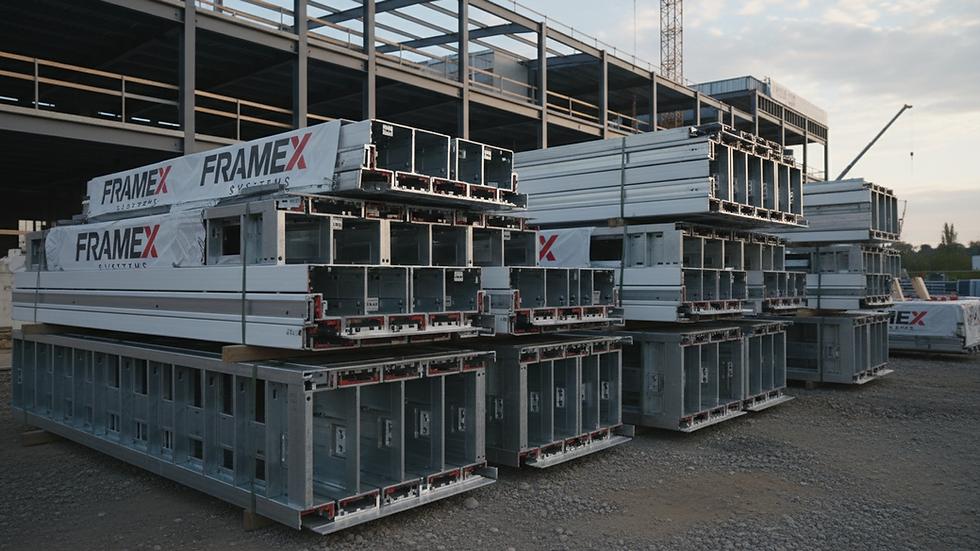
Frame X Systems approaches this as one connected workflow: design assist, engineering, digital coordination, factory production, and delivery all operate from the same resolved framing intent. That continuity reduces the handoffs where information is commonly lost.
Measure the Friction in Your Process
If framing submittals consistently take too long, measure where time is actually being consumed. Track the number of document revisions, average review duration, recurring RFI categories, unresolved coordination items at release, and field changes tied to framing information. Those indicators reveal whether the constraint is incomplete design input, slow decisions, unclear ownership, or insufficient coordination.
Do not judge the process only by the date a submittal receives approval. Judge it by what happens after approval. If installers still need frequent clarification, the process moved paper, not certainty.
The best next step is practical: on the next framing package, identify the five conditions most likely to create a field stop and require them to be resolved before release. That discipline changes the submittal from a compliance task into a schedule-control tool.


Comments